
Johan Agrell
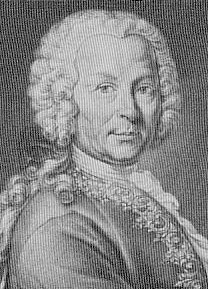
The only known (to us) portrait of Johan Agrell, an engraving by V. D. Preisler after a painting by J. J. Preisler, Nuremberg 1754. Detail.
Johan Agrell (1701–1765) was born in the Swedish province of Östergötland and studied music in Uppsala. Most of his professional career, however, was spent in Germany. He was recruited from Sweden to Kassel as a member of the royal orchestra, where he became famous as a virtuoso on both harpsichord and violin. In 1746 he moved to Nuremberg as the city’s director of music, which he remained until his death in 1765. He married Margaretha Förtsch in 1749 and had a daughter Ursula Barbara, who died in childbirth just like her mother [MS vol. 1, p. 67]. We do not know if he had any surviving grandchildren.
Although Johan Agrell was an appreciated musician and conductor, it is as composer he is remembered today. His music belongs to the very last part of the baroque era, in some details looking ahead into the Viennese classical school. He wrote concertos, sonatas, and various types of occasional celebration and church music. Valentin claims, citing Lindgren, that he was the originator of the “fully developed sonata form” [Valentin].
Unfortunately, much of Johan Agrell's work has been lost, and of what is preserved, only copies are known, not a single autograph [MS, vol. 1, p. 105; vol. 2, p. 7]. It was believed that all Agrell’s church music [Eppstein] and all his vocal music [Prophone] has been lost, but this is fortunately not entirely correct. Thanks to Morgenroth Sheerin [MS, vol. 2, pp. 5, 25] and W. Riedelbauch and R. Freund [personal communication], we now know that a library in Göttingen holds two manuscripts that contain a total of 17 motets by Johan Agrell [Gött].
Interestingly, Johan Agrell was among the first composers who wrote symphonies. According to different sources, he composed at least 22 [Lindfors], at least 28 [MS], or at least 32 [Heussner and Bengtsson] symphonies. Exactly when he wrote his first symphony remains somewhat obscure. Valentin claims that he composed his six symphonies opus 1 already in 1725 [Valentin], which was considerably before composers such as Sammartini and Stamitz, who are also known for early symphonies. Valentin concludes, citing Brenet, who in turn cites Fink, that “the oldes symphonies for full orchestra were those, which the Swedish composer Johan Agrell composed in 1725”. Another encyclopedia article [Heussner and Bengtsson] dates Agrell’s orchestra symphonies to the 1720s–1740s.
However, the above-mentioned datings of Agrell’s first symphonies to the 1720s are questioned by the main authority on the works of Johan Agrell, namely Jeannette Morgenroth Sheerin: “Although Fink exaggerated Agrell's claim to precedence, even a more reasonable approach to chronology places Agrell securely in the first generation of Classic symphonists” [MS, vol. 2, pp. 23–24]. According to her, the earliest certain dating is January 7, 1738, when Vivaldi conducted one of Agrell’s symphonies [MS, vol. 1, ch. 7], and his symphonies opus 1 cannot with certainty be dated before 1746 or 1747 [MS, vol. 1, ch. 3, 7]. However, “Agrell was among the first composers outside of Italy to compose concert symphonies.” [MS, vol. 1, p. 4].
Morgenroth Sheerin enumerated Agrell’s symphonies by their key followed by six integers corresponding to the six first notes in the lead violin. The key’s root note has number 1 and the other notes are numbered from 2 to 7. The numerical representation treats notes in different octaves and notes of different length identically. For example, the symphony op. 1 no. 1 has the Sheerin code D:111117, which indicates the sequence D–D–D–D–D–C#. In the music, these five Ds all have different lengths (!) and are located in two octaves, but this is not reflected in the code.
Johan Agrell and his brother Jonas were the first persons named Agrell in our family.

From Johan Agrell’s second symphony, op. 1 [Norling].
Recorded albums
- Johan Agrell, “Six Sinfonias op 1”, Nationalmusei Kammarorkester led by Claude Génetay (conductor), LP record, Polar POLS 349, 1981.
- Sinfonia op. 1:1 D major, D:111117
- Sinfonia op. 1:3 A major, A:111567
- Sinfonia op. 1:5 G major, G:131531
- Sinfonia op. 1:2 C major, C:531531
- Sinfonia op. 1:4 Bb major, Bb:551533
- Sinfonia op. 1:6 F major, F:317153
- Johan Agrell, “Konserter för flöjt och cembalo med stråkorkester”, Drottningholms Barockensemble with Stig Bengtsson (flute) and Eva Nordenfelt (harpsichord), LP record, Caprice CAP 1130, 1979.
- Double Concerto B minor (Swedish “h-moll”), op. 4 no. 2, for flute, harpsichord, and strings, printed 1753
- Double Concerto A major for flute, harpsichord, and strings, printed 1753
- Johan Agrell, “Sei Sonate per il Cembalo Solo”, Eva Nordenfelt (harpsichord), CD record, Prophone PCD 004, 1991.
- Sonata I, Bb major
- Sonata II, G major
- Sonata III, F major
- Sonata IV, E minor
- Sonata V, D major
- Sonata VI, G minor
- Johan Joachim Agrell, “Konzerte”, Music for Awhile with Wilbert Hazelzet (flute) and Matthew Halls (harpsichord, fortepiano), CD record, Cavalli Records CCD 423, 2002.
- Double Concerto A major for flute, harpsichord, and strings
- Double Concerto B minor (German “h-Moll”), op. 4 no. 2, for flute, harpsichord, and strings
- Double Concerto G major for flute, fortepiano, and strings
- Harpsichord Concerto A major for harpsichord and strings
- Johan Joachim Agrell, “Orchestral works”, Helsinki Baroque Orchestra with Sirkka-Liisa Kaakinen-Pilch (violin), Aapo Häkkinen (harpsichord), Pauliina Fred (flute), and Jasu Moisio (oboe), CD record, Aeolus AE-10047, 2010.
- Sinfonia A major for strings, flutes and basso continuo, A:551533
- Violin Concerto D major for violin, strings and basso continuo
- Double Concerto B minor, op. 4 no. 2, for harpsichord, flute, strings and basso continuo
- Sinfonia D major for strings and basso continuo, D:151515
- Oboe Concerto Bb major for oboe, strings and basso continuo
- Sinfonia Eb major for strings and basso continuo, Eb:131511
- Johan Joachim Agrell, “6 works for orchestra”, Drottningholms Barockensemble, CD record, Swedish Society SCD1189, 2023.
- Sinfonia in D-major, D:111345
- Sinfonia in B-flat major op. 1:4, Bb:551533
- Sinfonia in E-flat major, Eb:131511
- Sinfonia in C-major, C:531531
- Sinfonia in D-major, D:135175
- Sinfonia in D-major, D:171111
Other recordings
- “Two sides”, Barokkbandið Brák with Elfa Rún Kristinsdóttir (violin), double CD record, Sono Luminos SLE-70026, 2022?, includes two compositions by Johan Joachim Agrell in a collection of music by multiple composers.
- Violin Concerto in G major, for violin, harpsichord, and strings
- Sinfonia in A major, op. 1 no. 3, She A:111567
Sources
- Sara Norling, “Johan Agrell 300 år : En svensk musikexport med hemlängtan”, Tidig musik, no. 4, pp. 22–25, 2001.
- Hans Eppstein, “Johan Agrell”, text supplement of LP record “Konserter för flöjt och cembalo med stråkorkester”, Caprice CAP 1130, 1979.
- “Johan Agrell”, text supplement of CD record “Sei sonate per il cembalo solo”, Prophone, PCD 004, 1991.
- “Drottningholms Barockensemble : Johan Agrell 1701 – 1765 : Jubileumskonsert 300 år”, program for a concert in Borg church, Oct. 28, 2001, with texts by Jeannette Morgenroth, Bertil Färnlöf, and Anders Köhler.
- Karl Valentin, “Agrell, Johan”, in Svenskt biografiskt lexikon, vol. 1, 1918.
- Per Lindfors, “Agrell, Johan”, in Svensk uppslagsbok, 2nd ed., vol. 1, 1948.
- Horst Heussner and Ingmar Bengtsson, “Agrell, Johan”, in Sohlmans musiklexikon, 2nd ed., vol. 1, 1975.
- [MS] Jeannette Morgenroth Sheerin, The symphonies of Johan Agrell (1701–1765) : sources, style, contexts, Ph.D. Dissertation, Ann Arbor, MI, U.S.A., 1987.
- Stig Jacobsson, “Johan Agrell : liv och verk”, Kammarmusiknytt, no. 3, pp. 12–13, 2002. [Not studied by us]
- [Gött] Item “D Gs 8° Cod. Ms. philos. 84e: Sammelhandschrift 1”, manuscript in Niedersächsische Staats- und Universitätsbibliothek Göttingen. This 324-page compilation of scores by many composers is dated 1751 and includes 8 motets by Johan Agrell. Additional motets are in “Sammelhandschrift 2”. [Not studied by us]
Links
- Johan Agrell – ett musikaliskt porträtt på svenska, unpublished article by Mathias Henricson.
- Project Runeberg has a lot of free sheet music by Johan Agrell (in PDF, PS, or PMX) made available by Johan Tufvesson. A similar archive is Werner Icking Music Archive.
- The Classical Archives has some sheet music by Johan Agrell in MIDI and other formats.
- IMSLP is a vast archive of public domain music.